
Cash Flow Basics for Founders: Your First-Year Guide (2026)
Profit is not cash. The five cash flow mistakes that close first-year businesses, the five numbers to track weekly, and how to build a real buffer.



Why a profitable business runs out of money
Profit tells you whether your prices exceeded your costs over a period. Cash flow tells you whether money sits in the account on the day a bill comes due. Those are different questions with different answers. A consulting firm with a 20% margin and net-60 client terms still misses payroll on day 30 if no client has paid yet.
Under accrual accounting the invoice becomes revenue the moment you send it. The cash arrives weeks later, or in some cases never. That timing difference is the most common reason first-year founders are surprised by their own bank balance. Karen Mills, former Administrator of the US Small Business Administration and Senior Fellow at Harvard Business School, has observed that for owners "cash flow is on their mind pretty much all the time." The instinct is right. The measurement usually is not.
Profit and cash flow side by side
| Question | Profit (income statement) | Cash flow (bank reality) |
|---|---|---|
| What does it measure? | Revenue minus expenses over a period | Money actually received minus money actually paid |
| When is a sale counted? | When the invoice is issued | When the customer's payment clears |
| Does a loan show up? | No, only the interest portion | Yes, the full amount in and out |
| Does equipment purchase show up? | Spread over years as depreciation | In full, on the day you pay |
| Do owner draws show up? | No | Yes |
| Can it be positive while the other is negative? | Yes, frequently | Yes, frequently |
| Which one ends the business? | Neither directly | This one |
The last row is the point. A business fails when it cannot pay an obligation on the date it falls due, not when its income statement turns red. CB Insights, analyzing 431 venture-backed shutdowns since 2023, found that running out of capital appears in 70% of failures, while poor product-market fit sits behind 43%. Cash is usually the mechanism of death, not the disease. For a first-year founder, that distinction matters: fixing cash timing buys you the months you need to fix everything else.
Five cash flow mistakes that sink first-year businesses
Each mistake below includes the warning sign you will actually see and the specific correction.
Mistake 1: Treating a signed invoice as money in hand
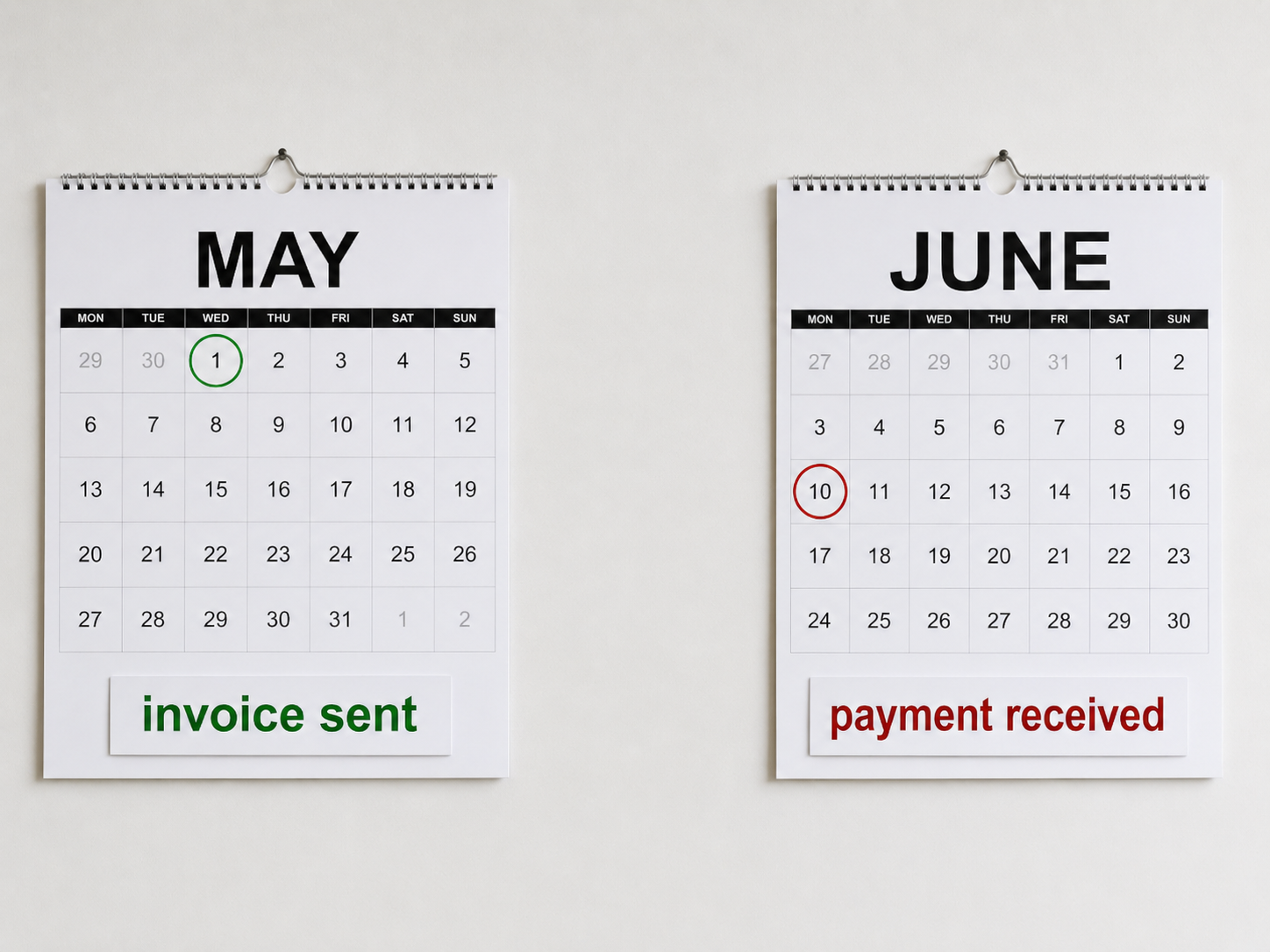
You finish the project, send the invoice, and mentally spend the money. The customer pays in 45 days, or 70, or after three reminders. Intuit QuickBooks' 2026 Small Business Late Payments Report found that 59% of US small businesses have invoices overdue by 30 days or more, up from 47% the previous year, with an average of $17,700 outstanding per affected business. The same report found that 49% of owners say standard payment processing times create critical or moderate cash-flow gaps even after the customer has paid.
Warning sign: your accounts receivable balance grows faster than your bank balance.
Fix: invoice on completion, not monthly. Set net-15 as your default for new clients rather than net-30. Turn on automatic payment reminders in QuickBooks, Xero, or Wave. Require a 30% to 50% deposit on any engagement above one month of your operating costs.
Mistake 2: Ignoring the gap between when you pay and when you get paid
Your suppliers want payment in 15 days. Your customers pay in 45. You are financing the difference out of your own pocket, every cycle, whether or not you have the cash to do it. This gap is the cash conversion cycle, and in year one it is often the difference between growth and insolvency. Growing sales makes the gap wider, not narrower, because every new order means paying costs earlier and waiting longer for revenue.
Warning sign: revenue is rising and your bank balance is falling.
Fix: write down your average days to get paid and your average days to pay suppliers. If the first number is larger, close the gap from both ends. Negotiate net-30 or net-45 with suppliers before you need it. Move your best customers to deposits or milestone billing.
Mistake 3: Operating with no cash buffer and no credit line
The JPMorgan Chase Institute analyzed 470 million transactions across 597,000 small businesses and found a median of 27 cash buffer days, the number of days a business could cover its outflows with zero incoming cash. A quarter of businesses held 13 days or fewer. Diana Farrell, then President and CEO of the Institute, framed the risk directly: "the consistency of their growth is in question if they're living month-to-month."
Warning sign: a single delayed customer payment forces you to move a supplier payment.
Fix: target 60 days of operating expenses in reserve. Build it in increments by moving a fixed percentage of every deposit into a separate account on the day it lands. Apply for a business line of credit while your revenue and balance sheet still look strong. Lenders price on your position today, not your need tomorrow.
Mistake 4: Spending money that belongs to the IRS or to payroll
Sales tax collected from customers is not revenue. Payroll withholdings are not yours. Estimated quarterly income tax is a bill with a fixed date. Founders in year one routinely see a healthy balance and forget that a meaningful share of it is already committed. The IRS applies penalties for underpayment of estimated tax and treats unpaid payroll trust fund taxes as a personal liability of responsible individuals under the Trust Fund Recovery Penalty.
Warning sign: you have never calculated what portion of your current balance is spoken for.
Fix: open a separate account for tax reserves. Transfer sales tax the week you collect it and set aside 25% to 30% of net profit for federal income tax as a starting estimate. Confirm the exact percentage with your accountant, since it depends on your entity type, state, and other income.
Mistake 5: Scaling costs on the strength of a contract, not on received cash
You sign a large client. You hire, lease space, and buy equipment against the expected revenue. The client delays the start, renegotiates, or pays late. Your new costs are fixed and immediate. The Startup Genome Project found that 74% of failed startups scaled prematurely, adding headcount and spend ahead of confirmed demand. In the Federal Reserve's 2026 Report on Employer Firms, 56% of firms that applied for financing did so to meet operating expenses, the single most common reason.
Warning sign: your fixed monthly costs rose before your average monthly collections did.
Fix: tie hiring to collected revenue over three consecutive months, not to signed contracts. Use contractors or fractional support until the revenue proves durable. Keep a written list of every cost you would cut, in order, if collections dropped 30%.
The five mistakes at a glance
| Mistake | Warning sign | First correction |
|---|---|---|
| Invoice treated as cash | Receivables grow, bank balance does not | Net-15 terms, deposits, automated reminders |
| Payment timing gap ignored | Sales up, cash down | Match supplier terms to customer terms |
| No buffer, no credit line | One late payment forces a scramble | Build to 60 days, open a line of credit early |
| Spending tax and payroll money | Never calculated committed cash | Separate reserve account, weekly transfers |
| Scaling on contracts | Fixed costs rise before collections | Hire against three months of collections |
Need help cleaning up your books?
Our bookkeeping specialists can organize your financial records, prepare accurate reports and help you stay tax compliant.
The five cash flow numbers to track in year one
You do not need a finance team. You need five numbers, reviewed weekly.
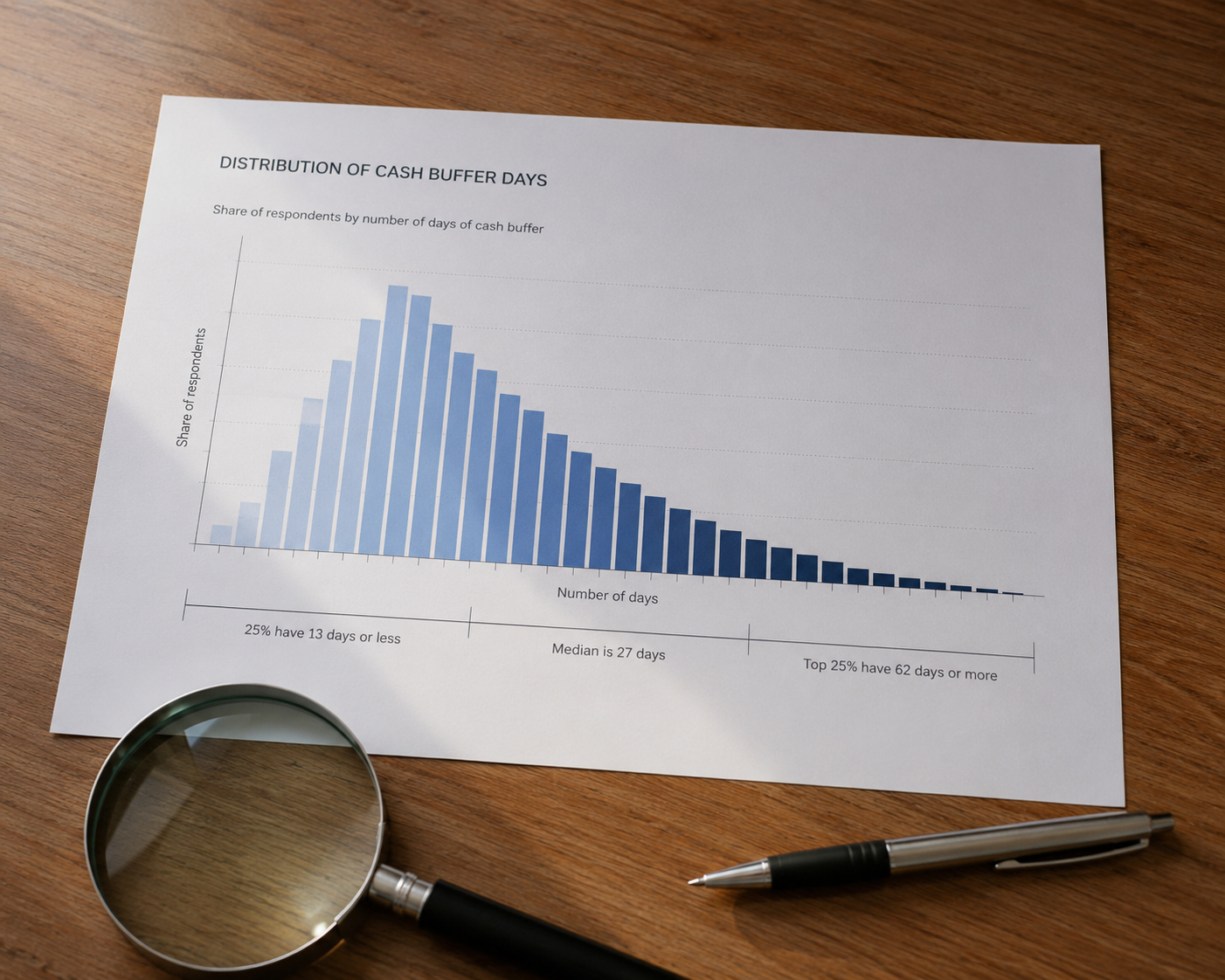
- Cash buffer days. Average daily cash balance divided by average daily cash outflows. This is the JPMorgan Chase Institute's own metric. Under 30 is fragile. Over 60 is stable.
- Operating cash flow. Cash generated by the business itself, excluding loans and owner contributions. If this is negative while you are profitable on paper, your problem is collections or timing, not pricing.
- Days sales outstanding (DSO). Accounts receivable divided by revenue, multiplied by days in the period. It tells you how long your money sits with customers. Track the trend, not the absolute number.
- Fixed monthly burn. Rent, payroll, software, insurance, debt service. Every cost that arrives whether or not you sell anything. This number sets your minimum survival threshold.
- 13-week rolling cash forecast. A simple week-by-week projection of expected inflows and known outflows. It is the standard tool in restructuring work because it surfaces the exact week you run short, while you still have time to act.
The 13-week forecast does the most work of the five. Build it in a spreadsheet before you buy software. If your model outgrows the spreadsheet, Float, Fathom, and Pulse all connect to QuickBooks or Xero and automate the projection.
How to choose your cash flow routine
The right routine depends on how money moves through your specific business, not on your revenue size.
- Choose a weekly manual review in a spreadsheet if: you bill fewer than 20 invoices a month, your costs are stable, and you have under $250,000 in annual revenue. The discipline of touching the numbers by hand builds the instinct. Software at this stage hides the mechanics from you.
- Choose accounting software with automated reminders if: you invoice clients on terms, you chase payments more than once a month, or you have any employees. QuickBooks Online and Xero both handle invoicing, reminders, and bank reconciliation. Wave is a lower-cost option for solo operators with simple needs.
- Choose a dedicated forecasting layer if: your revenue is seasonal, you carry inventory, you are planning a hire or a loan application, or you have more than one revenue stream with different payment terms. Float, Fathom, and Pulse sit on top of your accounting data and model scenarios.
- Choose a bookkeeper or fractional controller if: you are past roughly $500,000 in revenue, you have payroll in more than one state, or you have already missed a tax deadline. The cost of the mistake usually exceeds the cost of the help.
Three questions decide it for most founders:
- How many days pass between your work and your money? Longer gaps demand tighter tracking.
- How fixed are your costs? High fixed costs shrink your margin for error.
- What happens if your largest customer pays 60 days late? If the answer is "I cannot make payroll," you need the forecast now.
Sources and references
- JPMorgan Chase Institute, Cash is King: Flows, Balances, and Buffer Days (2016), analyzing 470 million transactions across 597,000 small businesses.
- Intuit QuickBooks, 2026 Small Business Late Payments Report.
- Federal Reserve Banks, 2026 Report on Employer Firms: Findings from the 2025 Small Business Credit Survey, 6,525 responses.
- LendingTree analysis of US Bureau of Labor Statistics Business Employment Dynamics survival data (April 2026).
- US Bureau of Labor Statistics, Business Employment Dynamics program.
- CB Insights, Why Startups Fail: Top Reasons, based on 431 venture-backed shutdowns since 2023.
- Karen G. Mills, "Government and Financial Tech Can Fix Cash Woes for Small Businesses," HBS Working Knowledge.
- Diana Farrell, quoted in JPMorgan Chase Institute announcement of Cash is King (September 2016).
- Startup Genome Project, premature scaling findings, as reported in startup failure analyses.
- Internal Revenue Service, Trust Fund Recovery Penalty and estimated tax requirements.
Cash flow problems rarely announce themselves. They accumulate quietly across four or five small decisions, then arrive on a single Friday when payroll is due. The founders who survive year one are not the ones with the best forecasting software. They are the ones who look at the same five numbers every week and act early when one of them moves.
If you want a second set of eyes on your numbers before the pressure builds, book a free consultation. We will walk through your cash position, your collection cycle, and the specific weeks that carry risk.
Need help cleaning up your books?
Our bookkeeping specialists can organize your financial records, prepare accurate reports and help you stay tax compliant.
Frequently asked questions
What is the difference between cash flow and profit for a small business?
Profit is revenue minus expenses over a period, recorded when transactions occur. Cash flow is money actually entering and leaving your bank account, recorded when it moves. A business can show a profit on its income statement while having no money to pay rent, because customers have not paid yet. Profit measures performance. Cash flow measures survival.
How much cash should a new business keep in reserve?
A common working target is 60 days of operating expenses, with 90 days preferred for seasonal or project-based businesses. The JPMorgan Chase Institute found the median small business holds only 27 cash buffer days, and 25% hold 13 days or fewer. Those medians describe the distribution, not a safe target. Calculate your own figure from your fixed monthly costs.
Why is my business profitable but has no money in the bank?
Four causes explain most cases: customers have not paid outstanding invoices, you bought equipment or inventory that the income statement spreads over time, you repaid loan principal which does not appear as an expense, or you took owner draws. Check accounts receivable first. It is the most common answer for service businesses.
What is a 13-week cash flow forecast and why does it matter?
It is a week-by-week projection of expected cash inflows and known cash outflows over the next quarter. It is standard practice in corporate restructuring because it shows the specific week a business runs short of cash, far enough ahead to act. For a first-year founder, it converts a vague worry into a date and an amount.
How do I get customers to pay invoices faster?
Invoice immediately on completion rather than on a monthly cycle. Set net-15 as your default for new clients. Require deposits on longer engagements. Enable online payment and automatic reminders in your accounting software. Make the late-payment consequence explicit in the contract before the first invoice, not after the first delay.
Should a first-year founder open a business line of credit?
Applying while your revenue and balance sheet are healthy is generally easier than applying under pressure, since lenders assess your current position. In the Federal Reserve's 2026 Report on Employer Firms, 56% of firms seeking financing did so to cover operating expenses. Compare the total cost of credit against your alternatives before committing, and treat a credit line as a bridge across timing gaps rather than a substitute for margin.
How often should I review cash flow in the first year?
Weekly, at a fixed time. Monthly review is too slow to catch a shortfall while you still have options, and daily review produces noise without insight. Look at your bank balance, overdue invoices, upcoming fixed costs, and the next four weeks of your forecast. Fifteen minutes is enough once the habit exists.
Continue reading
More from the Altemore Consulting blog.

How to Clean Up Messy Books Before Tax Season (Without Starting Over)
A step-by-step framework we use with clients who are months — sometimes years — behind. Reconcile the right accounts first, catch the deductions you're missing, and hand your CPA a clean file.

Shopify, Amazon, Stripe Bookkeeping: 7 Errors to Fix in 2026
Your payout is not your revenue. The seven Shopify, Amazon and Stripe bookkeeping errors that break your books — and the fee, tax and reconciliation fixes for each.

12 Small Business Tax Deductions Most Owners Miss in 2026
The 12 small business tax deductions owners miss in 2026, with IRS figures, OBBBA changes, and the mid-year mileage rate split.

Get Weekly Accounting Tips
Join thousands of entrepreneurs receiving bookkeeping and tax insights directly in their inbox.